How To Build A Brand Voice Prompt Template You Can Reuse Anywhere
Published · 6 min read
Reviewed by Andrew Liashok, Client Service Director, IN-STORE
Build a reusable brand voice prompt template with tone, vocabulary, constraints, and examples to keep marketing copy consistent.
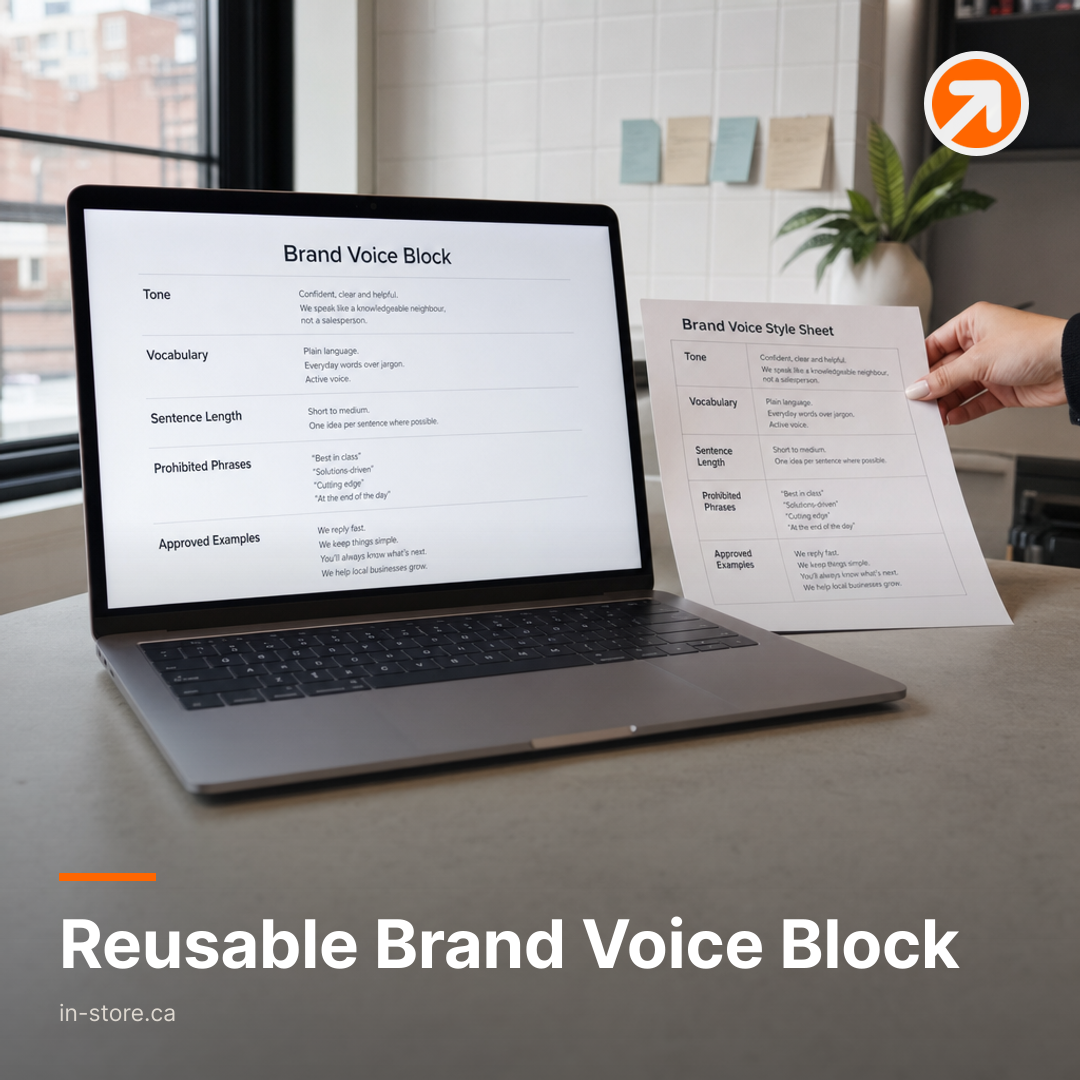
A Prompt Template That Keeps Marketing Copy Consistent Across Teams And Tools
Brand voice breaks first when output scales. One new freelancer, one busy week, one rushed landing page draft, and suddenly every channel sounds like a different company.
A reusable brand voice prompt template solves a practical problem for small and mid sized service businesses: it reduces editing time, cuts down on off brand drafts, and gives you a repeatable way to keep publishing without building an in house marketing team.
The core idea shows up consistently in official prompting guidance across vendors: be explicit about the outcome you want, provide clear context, specify constraints, and include examples when consistency matters.
What A Brand Voice Block Is And Why It Works
A brand voice block is a paste ready set of instructions you keep stable and reuse across the assets you produce every month: blogs, service pages, landing pages, email, social captions, ads, and Google Business Profile posts. You treat it as a shared standard, not a one off prompt.
OpenAI’s guidance on comprehensive prompting emphasizes giving instructions, context, and examples to guide output quality and adherence to requirements. Anthropic’s documentation similarly recommends structuring prompts for clarity and reliability, using prompt templates and variables for reuse, and using examples (few shot prompting) to show the desired pattern and style. Google’s Gemini guidance highlights clear, unambiguous instructions and specific keywords to shape responses. Microsoft’s Copilot guidance advises being clear about the desired outcome, then reviewing generated output for accuracy, completeness, tone, style, and safety before sharing.
The second order benefit, beyond faster drafting, is operational: your edits stop being one time fixes and start becoming training material. Each round of feedback can be turned into an approved example that makes the next draft closer.
The Six Parts To Include In Your Reusable Voice Block
1) Brand Personality And Tone Sliders
Start by defining your brand personality using deliberate tone sliders. Keep them plain and directional so they translate across formats. For a service business, it helps to specify how you want to sound when explaining process, pricing conversations, and customer outcomes.
Write these as instructions the writer can follow, for example: “confident and modern, with plain language” or “warm, direct, and practical.” Keep it short and stable so you do not rewrite it every time you create a new asset.
2) Vocabulary And Preferred Terms
List the vocabulary you want used consistently, including how you refer to customers, your services, and your deliverables. This is where many teams lose time because writers pick different labels each week, which later forces expensive editing across a website.
Include preferred customer terminology and your product or service naming. If you have phrases you always use, and phrases you never use, place both in the block so they are treated as constraints, not suggestions.
3) Sentence Length And Reading Level Targets
Define what “sounds like you” at the sentence level. Specify the sentence length preference, whether you want tight paragraphs, and whether you prefer short direct statements or longer explanatory passages. Consistency here matters because it affects how a reader experiences your brand across pages.
This part often improves output quality more than tone adjectives, because it gives a structural target the writer can hit repeatedly.
4) Formatting Rules
Formatting is part of voice. Decide how you want headings, bullets, and calls to action presented. If you prefer scannable sections with short paragraphs, say so. If you want a clear flow from problem to plan to expected business effect, state that pattern.
Also specify any channel rules you care about, such as whether you want a short opener followed by a sectioned body for blogs, or whether social captions should lead with the business consequence before details.
5) Prohibited Phrases And Overused Cliches
Create a short banned list of phrases that tend to creep into marketing copy and pull you off brand. This list becomes a quality filter. It is also an onboarding accelerator for new contributors because it prevents predictable tone drift.
Keep the list specific to your brand. The point is not to eliminate personality, it is to eliminate copy that sounds interchangeable.
6) Approved Examples (Including Before And After)
Examples are the fastest way to get consistent tone. Include a few short approved examples that represent your best writing, even if they are only a couple of sentences each. When you can, include a before and after pair to show what an off brand draft looks like and what you consider acceptable.
Anthropic points to examples and few shot prompting as a way to show the desired pattern. Treat these examples as reusable assets: each time you edit a draft, you can add the edited version to the example library.
A Practical Workflow To Make The Block Reusable
Draft It Once, Then Test It On Common Assets
After you draft your brand voice prompt template, test it on a small set of assets you create often. The workflow that tends to hold up is: write the block, test it on 3 to 5 common assets, then iterate using your edits as new examples. Over time, the block becomes a reliable prompt template you can use across tools and contributors.
Use Variables So You Do Less Rewriting
Prompt templates and variables are useful because you keep the voice stable while swapping the details that change. For example, you can keep the same voice block while changing the target audience, the offer, the service area, or the call to action. Anthropic’s prompt template guidance supports this approach: reuse a structured template and fill in variables rather than rewriting from scratch.
Make Review Part Of The System
Microsoft’s Copilot guidance explicitly calls out review for accuracy, completeness, tone, style, and safety before sharing. Build that review into your process as a standard step. Treat voice as something you inspect the same way you inspect a quote, a service description, or a client claim.
How IN STORE Uses This In A Monthly Content System
For businesses that need steady lead flow without an in house marketing team, the value of a brand voice block is that it becomes a control point inside an SMB growth system. It keeps your website presence, ongoing content, local visibility, and lead capture workflows speaking in one consistent voice, even when production happens on a monthly cadence.
IN STORE typically treats the voice block as a reusable part of guided intake and content planning, then refines it over time by turning real edits into approved examples. The goal is predictable output quality: fewer rewrites, faster approvals, and cleaner reuse across blogs, service pages, and lead gen workflows.
A strong brand voice prompt template is short, specific, and backed by examples. Once it is tested and stored as a shared template, it becomes an operating standard that protects quality as you publish more often.
If you want help building a reusable voice block and rolling it into an ongoing content and lead generation workflow, explore IN STORE’s subscription based marketing services.
Get help building and implementing a reusable voice block, explore IN STORE’s services.
Sources:
- Comprehensive next generation prompting
- Prompt templates and variables
- Prompting best practices
- Write prompts for Gemini
- Write effective prompts
More articles from IN-STORE · This article as Markdown · RSS