ARE YOUR MARKETING VENDORS PIPEDA-READY?
Published · 6 min read
Reviewed by Andrew Liashok, Client Service Director, IN-STORE
A Toronto SMB checklist for PIPEDA third party service providers: vendor audit list, due diligence questions, and contract controls.
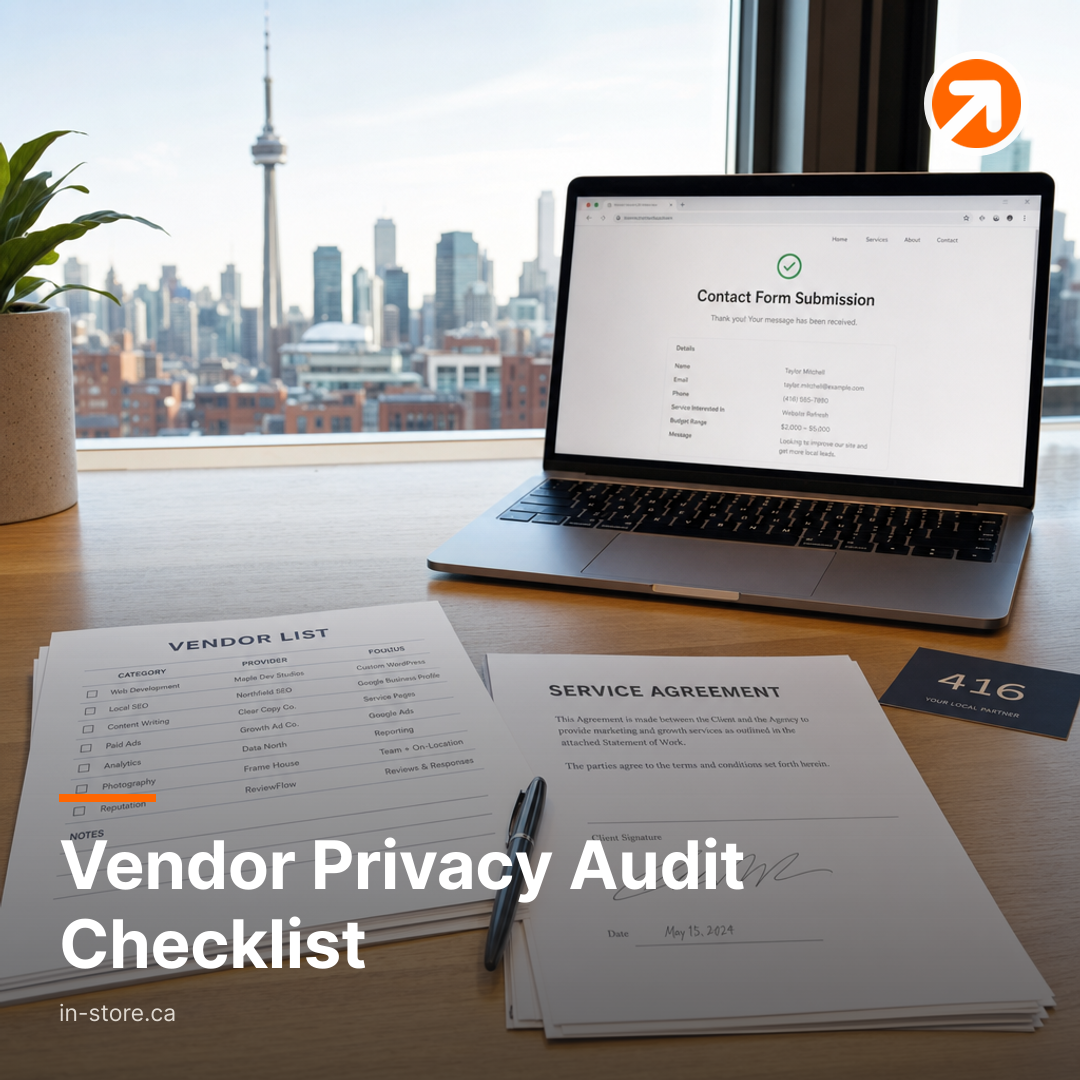
A Toronto SMB Contract Checklist Aligned To OPC Guidance On PIPEDA Accountability
Your marketing stack can quietly become your largest personal information footprint. Even when you do not “own” a tool, you still set it in motion: forms, chat, call tracking, email delivery, analytics, appointment booking, and ad measurement can all route customer details through third parties.
The Office of the Privacy Commissioner of Canada has released new guidance under PIPEDA focused on using third party vendors, and it is directly relevant to Toronto and GTA service businesses that rely on outside providers to run demand generation. A vendor audit is the fastest way to turn that guidance into practical action: identify the vendors that touch personal information, then tighten contracts and oversight where it matters.
Marketing Vendors That Commonly Touch Personal Information
Start your audit by listing every vendor that can receive, store, access, or process personal information on your behalf, even if they are “just” enabling lead capture or reporting. In a typical SMB setup, the list often includes:
- Website and hosting providers that store contact form submissions and site logs.
- Form, scheduling, and booking tools that collect names, emails, phone numbers, and appointment details.
- CRM and email service providers that store lead records and send follow ups.
- Call tracking, voicemail, and messaging providers that handle phone numbers and content of communications.
- Analytics and tag management tools that collect identifiers tied to web activity and conversion events.
- Advertising and measurement vendors that receive conversion signals from your site or lead workflows.
- Customer support tools such as chat widgets and ticketing systems that may capture identifiers and message history.
- Marketing agencies and contractors that have admin access to your accounts, dashboards, and lead data.
For each vendor, record what personal information is involved, how it enters the system, who can access it, and which business function depends on it (lead intake, follow up, reporting, customer service). This becomes your map for contract fixes and operational controls, instead of a generic “privacy review.”
A PIPEDA Third Party Service Providers Contract And Due Diligence Checklist
1) Accountability: Put The Relationship In Writing
OPC guidance on PIPEDA third party service providers centres on accountability. For a service business, the most practical translation is simple: treat each vendor relationship as a defined processing arrangement, documented in a contract, with clear expectations for how personal information is handled.
In your audit, flag any vendor that has access to lead records or customer communications but is operating with only a proposal, a statement of work, or email threads. Those may be adequate commercially, yet they often leave privacy expectations implicit. Move the privacy terms into the contract language your business actually manages.
2) Due Diligence: Verify What You Are Buying Operationally
“Privacy vendor due diligence” should be more than a checkbox. Owners and lean marketing leads can make it workable by turning it into a short, repeatable set of questions asked before purchase and again at renewal. The goal is to confirm how the vendor will handle the specific data flows in your marketing system, including lead capture, storage, access, and deletion.
One non obvious trade off shows up here: the more “all in one” your marketing execution becomes, the fewer vendors you oversee, but the more concentrated the impact of a single weak contract or weak access control. Due diligence matters most around your primary lead intake path and your system of record for contacts.
3) Contract Controls: Make Oversight Practicable
Marketing service provider contracts often fail because they contain high level promises without operational hooks. The checklist below keeps it implementable for an SMB team.
- Scope of services and data handling: define what services are being provided and what personal information the vendor will handle to deliver them.
- Roles and permitted uses: restrict how personal information can be used within the vendor relationship.
- Access management: specify who can access your accounts and data, and how access is granted and removed.
- Subcontracting control: require visibility into any downstream providers involved in delivering the service.
- Incident handling: set expectations for how privacy incidents will be identified, escalated, and managed between the parties.
- Retention and deletion: establish how long personal information is kept and what happens at the end of the relationship.
4) Ongoing Management: Treat Vendors As Part Of Your Lead System
OPC aligned oversight only works if it is tied to the way marketing runs month to month. Build a light routine around the vendors that touch personal information:
- Access review when staff change, vendors change, or a project ends.
- Workflow review whenever lead capture changes, such as a new form, new booking flow, or a new conversion event.
- Renewal review to confirm the service still matches the contracted data handling expectations.
This is also where a monthly marketing partner can reduce risk while improving execution. If one team owns the website, content publishing, local visibility work, and lead generation workflows, it becomes easier to document where personal information enters the system and to keep vendor access current.
How Toronto Service Businesses Can Run A Vendor Audit In One Work Session
A useful audit is short and specific. Aim to produce two outputs: a vendor list that names which tools and providers touch personal information, and a set of contract updates for the vendors that matter most to lead intake and follow up.
- List the lead journey steps: first visit, inquiry, follow up, booking, and ongoing communications.
- Attach vendors to each step: include your agency, web provider, forms, booking, CRM, email, analytics, and any call or messaging tools.
- Mark “system of record” vendors: where contacts and communications history live.
- Collect the governing documents: contracts, service agreements, and any scopes of work tied to data access.
- Prioritize fixes: start with vendors that have broad access or store the most sensitive parts of the lead record.
If your current setup is spread across multiple tools and freelancers, the audit can also double as an efficiency review. Consolidating workflows may reduce the number of places personal information travels, but only if the contracts and oversight are tightened accordingly.
For GTA service businesses, the practical takeaway from the OPC’s PIPEDA third party service providers guidance is operational: know which marketing vendors touch personal information, then make accountability real through vendor due diligence and contract controls you can actually maintain.
If you want a single team to map your lead flows, consolidate tools where it makes sense, and document how personal information moves through your marketing system, explore IN STORES Lead Generation Systems and ongoing marketing execution services.
Explore how IN STORES can map your lead flows, consolidate tools, and document vendor access: See IN STORES lead generation and marketing services.
Source: Office of the Privacy Commissioner of Canada
More articles from IN-STORE · This article as Markdown · RSS