YouTube Updates Branded Content Disclosures With New Controls and Auto Labels
Published · 6 min read
Reviewed by Andrew Liashok, Client Service Director, IN-STORE
Sponsor ready briefing on YouTube branded content disclosure, paid promotion labels, age and geographic controls, and a pre publish checklist.
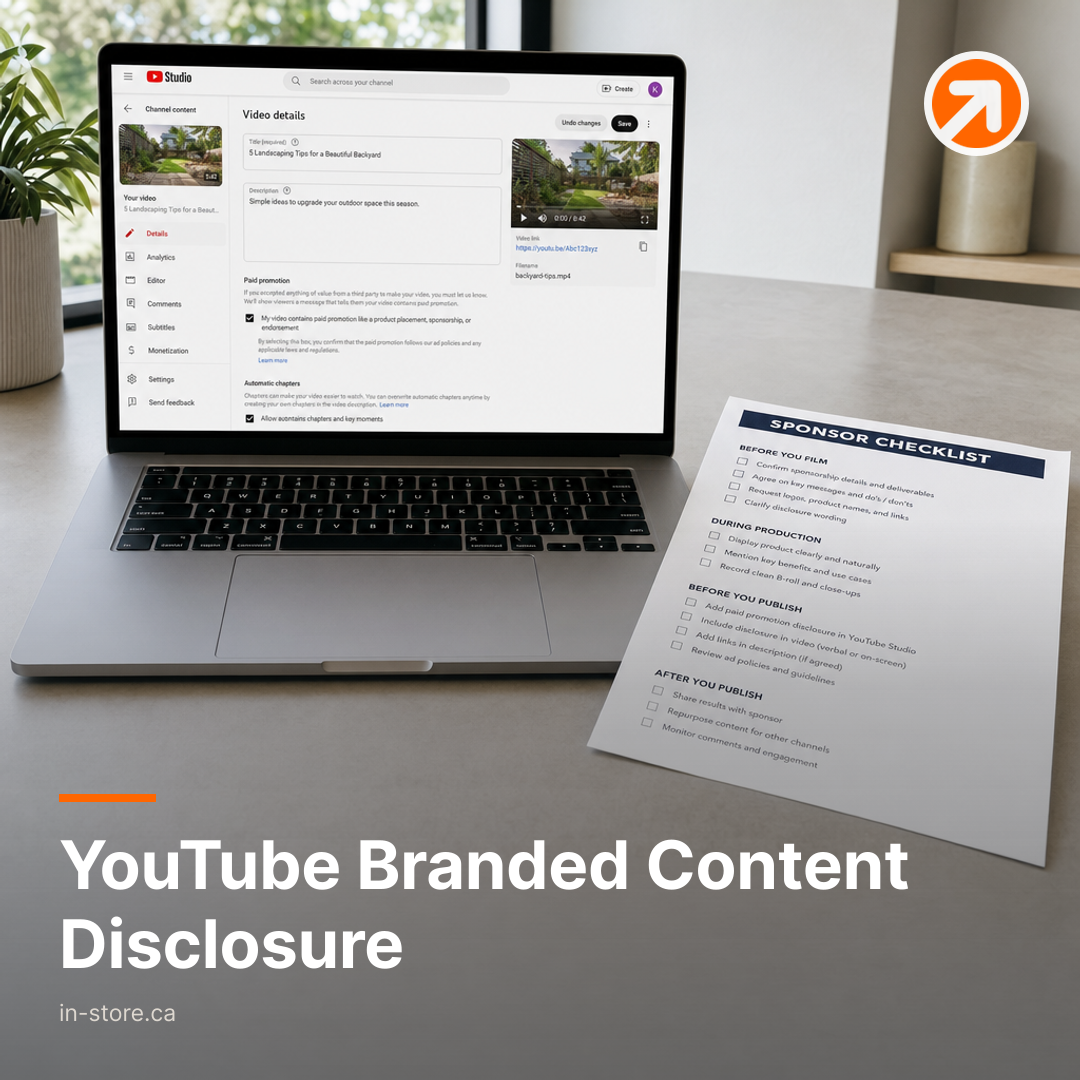
A Sponsor Ready Workflow For Paid Promotion Labels, Targeting Controls, And Pre Publish Checks
If you use creators and sponsorships to drive leads, your risk is rarely the creative. It is the publish step: a missing disclosure, inconsistent age or geographic limits, or a partner who forgets to flip the right Studio switch before the video goes live.
YouTube has posted updated guidance for branded content disclosure through its TeamYouTube channel, including a refreshed disclosure label, new manual age and geographic controls when creators declare paid promotion, and a plan to roll out automated detection that may apply disclosure labels when branded content is detected but not disclosed.
Below is a sponsor ready briefing you can hand to creator partners. It focuses on three things: what to do in YouTube Studio, what targeting restrictions to request, and a simple pre publish checklist you can attach to your contracts and review flow.
What YouTube Announced
In its TeamYouTube guidance titled “Giving you tools to easily disclose paid partnerships with new controls & automated disclosures,” YouTube described updates to branded content disclosures. The announcement includes a refreshed disclosure label and new manual controls for age and geographic settings when a creator declares paid promotion.
YouTube also said automated detection will roll out “in coming months.” When YouTube’s systems detect branded content that was not disclosed, YouTube said it may apply disclosure labels automatically.
Finally, YouTube said it refreshed related policy terminology to align to the term “branded content.” For sponsors, that terminology change matters because partner briefs, contracts, and internal review checklists tend to preserve old wording for years. Keeping your documentation aligned to YouTube’s current language reduces the odds of a sponsor and creator talking past each other during approvals.
Why This Changes Sponsor Control For Targeting
Two parts of the update have direct operational consequences for service businesses running creator led demand generation: controls connected to the creator’s paid promotion declaration, and automated labels that could appear even when a creator forgets to disclose.
Video Level Controls Need A Contractual Home
When controls sit inside the creator’s flow, enforcement depends on the creator doing the right thing at upload time. For sponsors, that shifts “targeting restrictions” from being a media plan line item to being a publication requirement. Your contract and approvals need to treat disclosure and restrictions as publish blocking items, handled before the video goes public.
Automated Labels Raise Brand Safety Risk In A New Way
Automated detection can change the failure mode. Previously, a creator could forget to disclose and the video might simply go live without the correct label. Under YouTube’s described direction, a missing disclosure can lead to an automatically applied label later if branded content is detected.
For a sponsor, the non obvious risk is timing. A label that appears after launch can change how the video looks to viewers mid campaign, potentially triggering internal questions (“why did this suddenly become labeled?”) and partner friction (“we already published, why are we revisiting settings?”). The practical answer is to move disclosure confirmation earlier and document it in your approvals.
A Sponsor Ready Studio Briefing For Creators
Use the wording below in your creator brief so both sides are aligned to YouTube’s terms.
Disclosure Step To Require
- Creators must declare paid promotion on videos that include a paid partnership, sponsorship, or other branded content arrangement that meets YouTube’s disclosure expectations.
- Sponsors should require proof of the setting as part of the approval package before the video is published.
Targeting Restrictions To Specify Upfront
YouTube’s announcement describes new manual age and geographic controls when creators declare paid promotion. For sponsors, this is the moment to make restrictions explicit, so the creator can set them correctly during publish.
- Age controls: specify any age restriction expectations in the statement of work for each deliverable.
- Geographic controls: specify any geographic restriction expectations in the statement of work for each deliverable.
Approvals Language That Matches YouTube’s Direction
Include an approval clause that treats disclosure and restrictions as release criteria. One practical structure is to require confirmation that the creator (1) declared paid promotion, and (2) applied the agreed age and geographic controls (if applicable), before a video can be made public.
Pre Publish Compliance Checklist For Sponsors
Attach this checklist to your internal review and to your creator partner workflow. It is designed for small teams that need repeatable controls without building a large compliance function.
- Contract language uses “branded content” terminology. Keep partner documents aligned to YouTube’s refreshed policy terminology so you are asking for the same setting YouTube expects.
- Disclosure requirement is explicit for each deliverable. The brief for each video should state that the creator must declare paid promotion when the content is a paid partnership.
- Age restrictions are written per video (if applicable). Put the expectation in writing so it can be applied using YouTube’s manual controls tied to the paid promotion declaration.
- Geographic restrictions are written per video (if applicable). Put the expectation in writing so it can be applied using YouTube’s manual controls tied to the paid promotion declaration.
- Publish proof is collected before public release. Ask for a clear confirmation step from the creator during the upload and publish process.
- Post publish monitoring is assigned. Since YouTube said automated detection may apply labels when branded content is detected but not disclosed, assign someone to spot check early in the campaign so surprises are caught fast.
How To Operationalize This Inside A Lean Marketing Team
Most sponsor problems happen when tasks are split across people: someone negotiates the partnership, someone else reviews the script, and a creator uploads late at night. The fix is to treat the YouTube publish step as part of your lead generation system, with a defined gate that lives alongside your creative approvals.
IN-STORE typically operationalizes this by turning your creator program into a simple workflow: intake for each deliverable, a documented approval path, and a repeatable publish checklist that your partners can follow. The goal is consistency, so disclosure and restriction settings are handled the same way every time, even when campaigns run across multiple creators.
If you want this to support steady lead flow, connect it to your web presence and follow up loop as well: where the video sends traffic, what the lead capture step is, and who owns the response. Those pieces do not replace YouTube compliance settings, they make the campaign measurable and manageable.
YouTube’s direction points to a tighter connection between paid promotion declaration and the controls that sponsors care about at the video level, plus an increased likelihood that undisclosed branded content could be labeled later through automated detection.
If you want help turning creator partnerships into a repeatable process with clear approvals, publishing checklists, and lead capture follow through, explore IN-STORE’s Marketing services for SMB growth systems.
Visit IN-STORE to discuss creator partnerships and marketing systems
Source: TeamYouTube
More articles from IN-STORE · This article as Markdown · RSS